
Industry · Agriculture and commodities
Agriculture and commodity data, cleaned and comparable
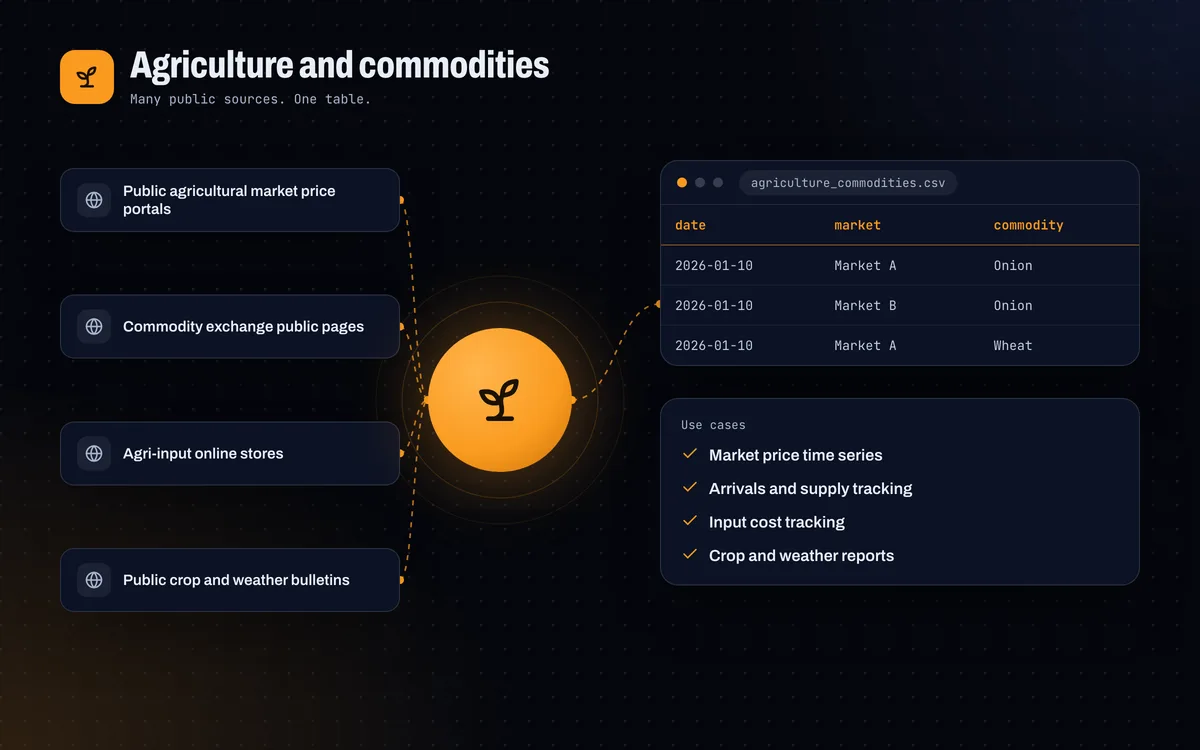
Agribusinesses, traders and food companies use public web data to follow crop prices, arrivals and input costs. We collect published market prices and arrivals, seed and fertiliser prices, and public crop and weather reports, and deliver them as one clean time series.
Prefer email? Write to sales@crawlmine.com. We reply within one working day.
Why tracking this market by hand fails
Market price data is published daily across many markets with inconsistent names for commodities, varieties and units. Gaps and outliers are common. Input prices sit on retailer and company sites in different formats.
Public sources we collect from
- Public agricultural market price portals
- Commodity exchange public pages
- Agri-input online stores
- Public crop and weather bulletins
We collect publicly visible, non-personal data and do not bypass logins.
Agriculture and commodities use cases for web data
How agriculture and commodities teams use scraped public data, and the fields that feed each use case.
- 01
Market price time series
Build clean daily price series by commodity, variety and market.
- commodity
- variety
- market
- modal price
- 02
Arrivals and supply tracking
Track arrivals volumes as a supply signal.
- market
- arrivals
- date
- 03
Input cost tracking
Record seed, fertiliser and agrochemical prices across sellers.
- product
- pack
- price
- seller
- 04
Crop and weather reports
Collect public crop progress and weather bulletins as structured data.
- region
- crop
- indicator
- value
How web data helps the business
The value is not the rows. It is the decisions your team can make with current, complete numbers.
Better buying
Procurement teams buy with daily prices across markets.
Clean models
Analysts forecast from consistent series, not patched spreadsheets.
Input cost visibility
Agribusinesses see input price moves as they happen.
A sample of the output
Every delivery uses one schema across all sources, with a source URL and collection timestamp on each row.
| date | market | commodity | variety | modal_price | arrivals_t |
|---|---|---|---|---|---|
| 2026-01-10 | Market A | Onion | Red | 1,850 | 412 |
| 2026-01-10 | Market B | Onion | Red | 1,920 | 238 |
| 2026-01-10 | Market A | Wheat | Lokwan | 2,640 | 96 |
Illustrative layout only. Real samples use your sites and fields.
Services for agriculture and commodities
Start with one, combine several. Each is built, run and maintained by us.
-

-

-
How it works
You see real data from your own sources before you commit to anything recurring.
- 01
Scope
You send the sites, fields, volume and schedule. We confirm what is practical and how it should be delivered.
- 02
Sample
We deliver a small sample or a paid pilot so you can check coverage and quality.
- 03
Production
We run the feed on schedule, monitor every source and fix scrapers when sites change.
Questions buyers ask
Not covered here? Ask in the quote form and we will answer with your scope.
How do you handle inconsistent commodity names?
We map commodity, variety and unit names to one list and keep the original as published.
Can you backfill history?
Yes, as far back as the public source shows.
What about missing days?
We record gaps explicitly instead of filling them, so your models see what was published.
Other industries
See all industries or browse every use case.


Talk to us directly
sales@crawlmine.comTell us about your agriculture and commodities data needs. A person on our team reads every message.

Send us the sites tonight. Data by morning.
Tell us which websites and fields you need. We confirm what is practical, how it should be delivered and what it costs.
- Goes straight to sales@crawlmine.com
- Reply within one working day
- A sample or pilot before any recurring plan
- NDA available before you share details
Request received.
Thanks. It is with our team at sales@crawlmine.com, and we reply within one working day.